

Your Guide to the United States of EPR
Uncategorized
December 17, 2025
Uncategorized
December 17, 2025
In both the US and EU, new legislation is shifting the costs related to the management of waste from municipalities to producers. Known as Extended Producer Responsibility (EPR), these laws turn packaging from a simple operational cost into a compliance issue, with new considerations for packaging strategies based on their recycling potential.
Extended Producer Responsibility (EPR) makes producers financially responsible for managing the waste from their packaging. This includes costs for collection, sorting, and recycling. The goal is to encourage more sustainable packaging design and fund the infrastructure needed to process waste effectively, which in the past has been a cost absorbed by consumers and municipalities.
Although the core concepts of EPR have already been explored and expanded for years in Europe, it has also gained momentum in the United States, creating a regulatory landscape that requires careful navigation based on the fact that current legislation for packaging EPR has been driven on a state level.
Learn more about the Packaging and Packaging Waste Regulation in the EU
Although the core concepts of EPR have already been explored and expanded for years in Europe, it has also gained momentum in the United States, creating a regulatory landscape that requires careful navigation based on the fact that current legislation for packaging EPR has been driven on a state level
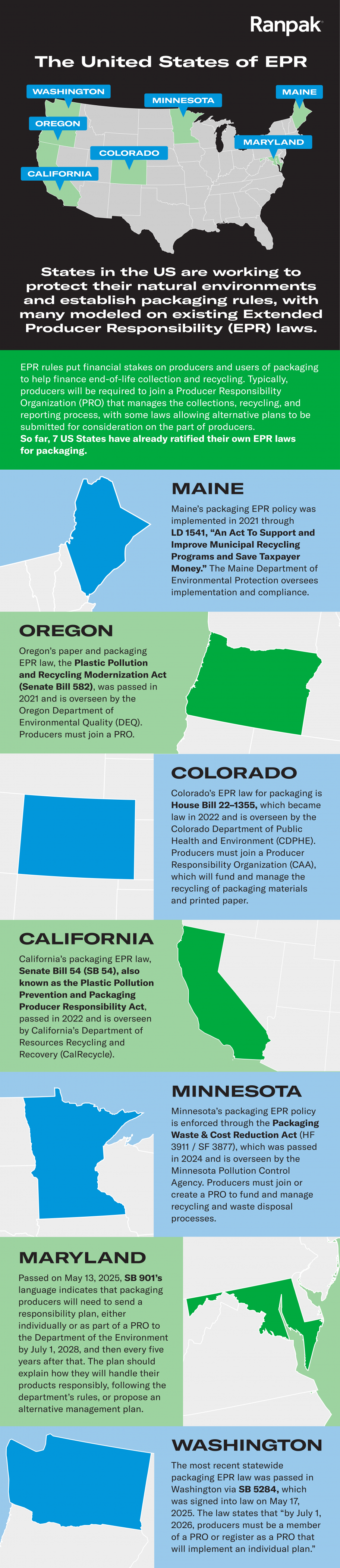
For logistics executives and operational leaders, tracking these state-specific requirements is critical for maintaining compliance and avoiding market disruption. The following summary outlines the key legislation, enactment dates, and critical deadlines for the seven states leading this shift.
Maine was the first state to adopt a dedicated EPR law for packaging, setting the precedent for producer responsibility in the US.
Legislation: An Act To Support and Improve Municipal Recycling Programs and Save Taxpayer Money (LD 1541)
Enacted: July 2021
Key Provisions:
Critical Deadlines:
Oregon’s approach emphasizes shared responsibility, integrating producer obligations with existing recycling infrastructure.
Legislation: Plastic Pollution and Recycling Modernization Act (SB 582)
Enacted: August 2021
Key Provisions:
Critical Deadlines:
Colorado’s legislation focuses on creating a fully producer-funded recycling system for all residents.
Legislation: Producer Responsibility Program for Statewide Recycling Act (HB22-1355)
Enacted: June 2022
Key Provisions:
Critical Deadlines:
California enacted one of the most comprehensive EPR laws, combining responsibility with aggressive waste reduction targets.
Legislation: Plastic Pollution Prevention and Packaging Producer Responsibility Act (SB 54)
Enacted: June 2022
Key Provisions:
Critical Deadlines:
Minnesota’s law is notable for its broad stakeholder engagement and specific waste reduction targets.
Legislation: Packaging Waste and Cost Reduction Act (HF 3911 / SF 3877)
Enacted: May 2024
Key Provisions:
Critical Deadlines:
Maryland has taken a foundational step by authorizing a needs assessment to determine the future structure of its EPR system.
Legislation: SB 901 (the Packaging and Paper Products – Producer Responsibility Plans Act)
Enacted: May 13, 2025
Key Provisions:
Critical Deadlines:
The most recent law to pass, the WRAP Act joins the fold of packaging EPR laws enacted on a state level.
Legislation: SB 5284 (the Recycling Reform Act, or WRAP Act)
Enacted: May 17, 2025
Key Provisions (SB 5022):
Critical Deadlines:

You are now leaving the Ranpak website. The website you will be entering is not owned or operated by Ranpak and/or its subsidiaries. The content, products and information contained on third party websites are not owned or controlled by Ranpak and/or any of its subsidiaries. Therefore, Ranpak makes no representations about, does not endorse or adopt, and is not responsible or liable for damages relating to the third party, its products or services, its website, its privacy policies or practices, or the content of the third party website.

